Canvas Aspect Ratios Explained: 1:1, 4:5, 3:4, 2:3, and More
Compare canvas aspect ratios including 1:1, 4:5, 3:4, 2:3, 3:2, and 11:14 with matching painting sizes, scaling examples, and crop guidance.
Published · 11 minute read
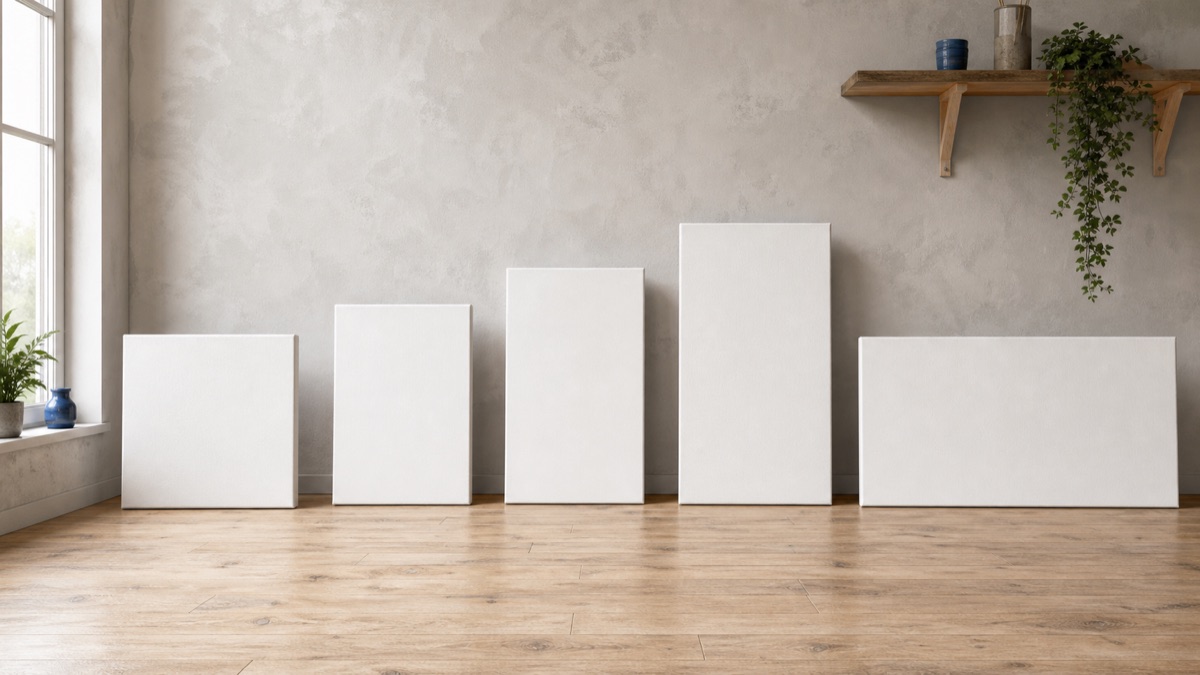
Compare canvases in common aspect ratios
These standard sizes represent three of the ratios covered below. Check the size guide before choosing a surface.
-
8×10 inch canvas
A compact 4:5 format for portraits and studies.
-
18×24 inch canvas
A versatile 3:4 format with more working room.
-
24×36 inch canvas
A large 2:3 format for photo-based compositions.
Some links are affiliate links. As an Amazon Associate, Canvas Calculator earns from qualifying purchases. Recommendations are based on size compatibility, not commission.
A canvas aspect ratio describes its width compared with its height, independent of physical size. An 8×10 canvas and a 16×20 canvas both reduce to a 4:5 ratio, so the same composition can scale between them without ratio cropping. A 12×16 or 18×24 canvas uses 3:4, while a 24×36 canvas uses 2:3.
Use the ratio to choose the shape first, then choose the physical dimensions that fit the subject, wall, budget, and working distance.
Common canvas aspect ratio chart
| Canvas ratio | Common painting sizes | Shape and typical uses |
|---|---|---|
| 1:1 | 8×8, 12×12, 16×16, 24×24 | Square compositions, icons, grids, centered subjects |
| 4:5 | 8×10, 16×20, 24×30 | Compact portraits, still lifes, traditional wall art |
| 3:4 | 9×12, 12×16, 18×24, 30×40, 36×48 | Portraits, landscapes, teaching, and general studio work |
| 2:3 | 12×18, 20×30, 24×36 | Full figures, photography-based work, elongated landscapes |
| 11:14 | 11×14, 22×28 | Common frame family with proportions between 4:5 and 3:4 |
| 5:7 | 5×7, 10×14, 15×21 | Small portraits, studies, cards, and gifts |
| 1:2 | 10×20, 12×24, 18×36 | Panoramas, skylines, and long horizontal or vertical subjects |
The ratio is always written width:height. Rotating a 12×18 canvas changes the displayed ratio from 2:3 in portrait orientation to 3:2 in landscape orientation, but the canvas shape and area stay the same.
Compare exact dimensions, centimeter conversions, and shape families in the Canvas Size Chart.
How to calculate a canvas ratio
Divide both dimensions by their greatest common divisor.
Example: 16×20 canvas
The greatest common divisor of 16 and 20 is 4:
- 16 ÷ 4 = 4
- 20 ÷ 4 = 5
- The reduced ratio is 4:5
Example: 18×24 canvas
The greatest common divisor of 18 and 24 is 6:
- 18 ÷ 6 = 3
- 24 ÷ 6 = 4
- The reduced ratio is 3:4
For decimal dimensions or an unfamiliar format, enter the width and height in the Canvas Aspect Ratio Calculator. It reduces the ratio, identifies the closest common proportion, finds matching standard canvases, and estimates fill cropping.
Canvas ratio versus canvas size
Ratio and size answer different questions:
- Aspect ratio describes shape. Every 4:5 rectangle has the same proportions.
- Canvas size describes physical dimensions. An 8×10 and a 24×30 share a 4:5 ratio, but the larger canvas has nine times the face area.
- Orientation describes which edge is horizontal. An 18×24 canvas is 3:4 in portrait orientation and 4:3 when rotated to landscape.
Matching the ratio preserves the composition. Choosing the size determines detail capacity, material use, viewing distance, framing, and wall presence.
Common Aspect Ratios in Art
1:1 square ratio
A 1:1 canvas has equal width and height. Square formats create a stable, centered field without a built-in horizontal or vertical direction. They suit geometric work, centered portraits, abstract studies, grids, and multi-piece arrangements.
Because the sides are equal, rotating a square does not change its ratio. Common sizes include 8×8, 12×12, 16×16, and 24×24 inches.
4:5 canvas ratio
The 4:5 family includes 8×10, 16×20, and 24×30 inches. Its compact rectangle gives portraits and still lifes enough direction without feeling extremely tall or wide.
A composition prepared at 8×10 can enlarge exactly to 16×20 or 24×30. Each pair of dimensions uses the same multiplier, so no ratio crop is needed.
3:4 canvas ratio
The 3:4 family includes 9×12, 12×16, 18×24, 30×40, and 36×48 inches. It is slightly longer than 4:5 and works for portraits, landscapes, demonstrations, and general studio painting.
An 18×24 reference scales exactly to 30×40 because both dimensions multiply by 1.6667. A 12×16 reference scales exactly to 18×24 because both edges multiply by 1.5.
2:3 and 3:2 canvas ratios
The 2:3 family includes 12×18, 20×30, and 24×36 inches in portrait orientation. Rotate the canvas and the ratio becomes 3:2. The longer shape suits standing figures, broad landscapes, and compositions adapted from a 3:2 photograph.
Moving from 2:3 to 4:5 without adding borders requires cropping the longer dimension. Check the subject’s headroom and side space before selecting a different ratio.
11:14 canvas ratio
An 11×14 canvas does not reduce to another whole-number ratio. At about 0.786 wide for every 1 unit high in portrait orientation, it falls between 4:5 and 3:4.
An 8×10 image is close but not identical. Filling 11×14 requires a small crop from the left and right or extra image area at the top and bottom, depending on how the source is fitted.
Panoramic canvas ratios
Ratios of 1:2, 1:3, or wider create a pronounced panoramic shape. Examples include 10×20, 12×24, and 18×36. They suit skylines, seascapes, long walls, diptych-like compositions, and narrow vertical subjects when rotated.
Panoramic formats often require custom framing and more deliberate wall planning than common 4:5 or 3:4 sizes.
How Aspect Ratio Affects Composition
Landscape orientation
A horizontal canvas gives the eye more room to travel from side to side. It suits landscapes, group portraits, interiors, and sequences of related elements. The wider the ratio, the more deliberately the composition must connect its left, center, and right areas.
Portrait orientation
A vertical canvas emphasizes height. It suits standing figures, trees, buildings, and compositions with a strong upward or downward movement. Taller ratios such as 2:3 provide more space around a full figure than a compact 4:5 canvas.
Square orientation
A square has no dominant direction. That can support centered symmetry, but it does not require it. Off-center subjects, diagonals, and unequal negative space can keep a square composition active.
Choosing the Right Aspect Ratio
Match the subject
- Head-and-shoulders portrait: 4:5 or 3:4
- Full standing figure: 2:3 or 3:4 in portrait orientation
- General landscape: 4:3, 3:2, or 2:1 in landscape orientation
- Centered or geometric design: 1:1
- Wide skyline or seascape: 1:2 or wider
These are starting points, not rules. The useful ratio is the one that supports the subject and intentional negative space.
Match the reference image
Check the source image ratio before transferring a drawing. If the photo and canvas share a ratio, the full image fits without ratio cropping. If they differ, choose among three deliberate options:
- Crop part of the source.
- Add background or borders to the short dimension.
- Choose a canvas with a closer ratio.
Do not stretch one axis to force a fit; that distorts the subject.
Match the display
The ratio affects how a work occupies a wall, but the physical size determines coverage. A panoramic canvas may fit above wide furniture, while a portrait canvas can suit a narrow wall or vertical architectural space.
After choosing the ratio, use the Wall Art Size Calculator to compare the selected width with actual wall or furniture measurements.
How to scale without changing the ratio
Multiply both dimensions by the same number:
- 8×10 multiplied by 2 becomes 16×20.
- 9×12 multiplied by 2 becomes 18×24.
- 12×18 multiplied by 2 becomes 24×36.
If only one dimension is known, use the ratio to calculate the other. For a 4:5 canvas that must be 24 inches high:
- Width = 24 × 4 ÷ 5
- Width = 19.2 inches
- The exact 4:5 result is 19.2×24 inches; the nearby stocked 16×20 and 24×30 sizes also preserve 4:5.
Canvas ratio questions
What is the most common canvas aspect ratio?
There is no single universal ratio, but 4:5 and 3:4 contain many widely stocked artist canvas sizes. The standard canvas size chart shows which dimensions belong to each family.
What ratio is a 16×20 canvas?
A 16×20 canvas reduces to 4:5. It matches 8×10 and 24×30 exactly.
What ratio is an 18×24 canvas?
An 18×24 canvas reduces to 3:4 in portrait orientation or 4:3 in landscape orientation. It matches 9×12, 12×16, 30×40, and 36×48.
Is 11×14 the same ratio as 8×10?
No. An 11×14 canvas uses an 11:14 ratio, while 8×10 reduces to 4:5. The shapes are close, but a full-bleed image needs a small crop or extension when moving between them.
Does changing canvas size change the aspect ratio?
Only if the two dimensions change by different scale factors. Moving from 8×10 to 16×20 preserves 4:5. Moving from 8×10 to 12×16 changes the ratio from 4:5 to 3:4.
Which ratio should I use for a portrait?
Use 4:5 for a compact head-and-shoulders composition, 3:4 for more torso or background, and 2:3 for a taller full-figure composition. The portrait canvas size guide compares specific dimensions for each crop.
Related canvas and artist guides
- Canvas Orientation Guide: Portrait, Landscape, and Square — Compare portrait, landscape, square, and panoramic canvas formats. See how orientation changes composition space, cropping, scale, and display choices.
- Portrait Canvas Sizes: Standard Dimensions for Every Portrait — Compare portrait canvas sizes for headshots, half-length and full figures, commissions, wall display, inches, centimeters, and aspect ratios.
- Painting Sizes Chart: Standard Canvas Dimensions for Artists — Compare standard painting and canvas sizes from 4×6 to 36×48 inches, with centimeter conversions, aspect ratios, uses, framing, and choosing tips.