Portrait Canvas Sizes: Standard Dimensions for Every Portrait
Compare portrait canvas sizes for headshots, half-length and full figures, commissions, wall display, inches, centimeters, and aspect ratios.
Published · 9 minute read
Compare popular portrait canvases
These portrait-friendly standards cover compact commissions through larger focal pieces.
-
11×14 inch canvas
Portable and well suited to head-and-shoulders studies.
-
16×20 inch canvas
A classic 4:5 proportion for individual portraits.
-
18×24 inch canvas
More vertical room for half-length or detailed portraits.
Some links are affiliate links. As an Amazon Associate, Canvas Calculator earns from qualifying purchases. Recommendations are based on size compatibility, not commission.
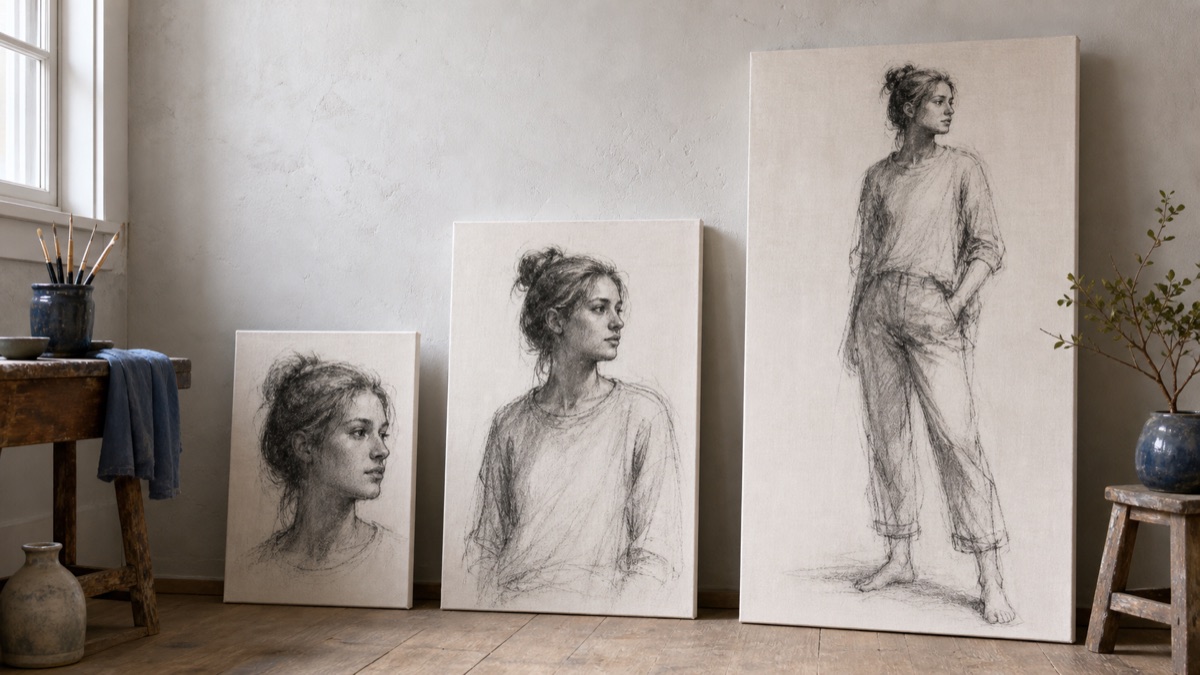
The best portrait canvas size depends on how much of the subject you show, the amount of detail you need, and where the finished work will hang. For most painted portraits, 11×14, 16×20, and 18×24 inches are the most practical starting points. Smaller formats suit headshots and studies; 24×30, 24×36, and 30×40 give half-length or full-figure portraits more presence.
Quick portrait canvas size guide
- 8×10 inches (20.3×25.4 cm): head studies, gifts, and small framed portraits
- 9×12 inches (22.9×30.5 cm): head-and-shoulders studies and portable commissions
- 11×14 inches (27.9×35.6 cm): detailed headshots, pet portraits, and small wall pieces
- 12×16 inches (30.5×40.6 cm): bust portraits and compositions needing a little more space around the subject
- 16×20 inches (40.6×50.8 cm): versatile commissioned portraits and half-length figures
- 18×24 inches (45.7×61 cm): larger half-length portraits, demonstrations, and statement pieces
- 24×30 inches (61×76.2 cm): substantial portraits with room for clothing, hands, and background
- 24×36 inches (61×91.4 cm): full-length figures and tall 2:3 compositions
- 30×40 inches (76.2×101.6 cm): large commissions intended to command a room
These dimensions describe the unframed canvas. A frame can add several inches to the final outside width and height.
Best small canvas sizes for portrait studies
8×10 portrait canvas
An 8×10 canvas has a 4:5 aspect ratio. It is large enough for a recognizable head-and-shoulders portrait but compact enough for quick studies, gifts, and grouped displays. The format is easy to carry and has many ready-made framing options.
The tradeoff is working room. Subtle hands, elaborate clothing, and a detailed environment can feel crowded. If the face is the priority, crop the reference deliberately rather than shrinking the entire figure onto the canvas.
9×12 portrait canvas
A 9×12 canvas uses a 3:4 ratio. Compared with 8×10, it is slightly taller for the same general scale, which creates more breathing room above and below the face. It works well for drawing classes, plein-air portrait studies, and single-session paintings.
11×14 portrait canvas
An 11×14 canvas offers about 93 percent more face area than 8×10. It remains portable but gives the artist more room for facial transitions, hair, clothing, and a modest background. It is a strong default for pet portraits and head-and-shoulders commissions.
Its 11:14 proportion is close to, but not exactly, 4:5. A reference prepared for an 8×10 print may need a small crop or extra background when transferred to 11×14.
Best medium canvas sizes for commissioned portraits
16×20 portrait canvas
A 16×20 canvas preserves the same 4:5 ratio as 8×10 while providing four times the face area. This makes it a dependable choice for a formal head-and-shoulders portrait or a half-length figure. It has enough room for controlled detail without the paint, storage, and shipping demands of a very large canvas.
Because 8×10 and 16×20 share a ratio, a correctly composed 8×10 reference can scale directly to 16×20 without cropping.
18×24 portrait canvas
An 18×24 canvas uses a 3:4 ratio. Its three square feet of surface give a portrait noticeably more presence than 16×20. The taller proportion is useful for half-length figures, seated poses, and compositions that include hands.
Choose 18×24 when the work needs to read from farther away or when the pose benefits from more vertical space. Check the available wall before committing: the frame will make the final piece larger than the canvas dimensions.
24×30 portrait canvas
A 24×30 canvas returns to the 4:5 ratio. It works for substantial half-length portraits and multi-subject compositions where faces still need enough scale to hold detail. It also enlarges cleanly from 8×10 or 16×20 references.
Large portrait canvases and full figures
24×36 portrait canvas
A 24×36 canvas has a 2:3 ratio. In portrait orientation, the taller shape accommodates a standing figure more naturally than 4:5. It is also useful when clothing, gesture, or an environmental background carries part of the story.
A 4:5 photograph will not fill a 2:3 canvas without either cropping the sides or extending the image at the top and bottom. Use the aspect ratio calculator before transferring the composition.
30×40 portrait canvas
A 30×40 canvas uses a 3:4 ratio and creates a strong focal point. It provides enough room for large facial features, expressive brushwork, hands, clothing, and surrounding context. It is appropriate for major commissions and rooms with enough viewing distance.
This size requires more than artistic confidence. Confirm easel capacity, doorway clearance, transportation, framing cost, and the final hanging location before beginning.
Match canvas size to the portrait crop
Headshot or face study
Use 8×10, 9×12, or 11×14. Keep the head large enough that the eyes, mouth, and major plane changes are not compressed into a tiny portion of the surface.
Head-and-shoulders portrait
Use 11×14 or 16×20 for most single subjects. Move to 18×24 when the background, clothing, or brushwork needs more room.
Half-length portrait
Use 16×20, 18×24, or 24×30. Hands often become important at this crop, so allow enough surface area to paint them with the same care as the face.
Full-length portrait
Use 24×36 or 30×40. A taller 2:3 or 3:4 ratio usually fits a standing figure better than a compact 4:5 rectangle.
Couple or family portrait
Consider turning 16×20, 18×24, 24×30, or 30×40 to landscape orientation. The number of subjects matters less than the final size of each face: adding people without enlarging the canvas reduces the detail available for every subject.
Choose the aspect ratio before the dimensions
Canvas dimensions and composition are separate decisions. First choose the shape that fits the reference, then select a physical size in that ratio.
- 4:5: 8×10, 16×20, and 24×30; compact and well suited to head-and-shoulders portraits
- 3:4: 9×12, 12×16, 18×24, and 30×40; slightly taller with more room for torso and gesture
- 2:3: 12×18, 20×30, and 24×36; tall enough for full figures and environmental portraits
- 11:14: 11×14; a common frame size with proportions between 4:5 and 3:4
Enter the reference dimensions in the Canvas Aspect Ratio Calculator to reduce the ratio, compare standard matches, and estimate cropping.
Account for the wall and frame
A portrait that feels large on an easel can look small above a sofa or on a broad wall. Measure the available wall area and compare the framed outside dimensions, not only the canvas.
Use the Wall Art Size Calculator to compare the canvas with a measured wall or furniture width. For a grid of multiple portraits, include the gaps between frames when calculating the total arrangement width.
Portrait canvas size mistakes to avoid
- Choosing only from the source photo size: A phone photo can have a different ratio from a standard canvas.
- Making the face too small: Detail depends on the size of the face within the composition, not merely the canvas label.
- Ignoring the frame: The finished outside dimensions can be several inches larger.
- Scaling up without increasing viewing distance: Large brushwork often needs more distance to resolve.
- Forgetting transportation: A large finished portrait must clear doors, stairs, vehicles, and delivery routes.
- Using a nonmatching ratio without a crop plan: Decide whether to crop, add background, or change canvas proportions before drawing.
A practical default
If you are uncertain, start with 11×14 for a compact portrait, 16×20 for a versatile commission, or 18×24 for a larger half-length work. These sizes are widely available, manageable in a studio, and large enough for meaningful facial detail.
Compare all common formats in the Canvas Size Chart, then use the Wall Art Size Calculator to compare the selected width with a measured wall or furniture piece before purchasing the canvas or frame.
Related canvas and artist guides
- Painting Sizes Chart: Standard Canvas Dimensions for Artists — Compare standard painting and canvas sizes from 4×6 to 36×48 inches, with centimeter conversions, aspect ratios, uses, framing, and choosing tips.
- Canvas Aspect Ratios Explained: 1:1, 4:5, 3:4, 2:3, and More — Compare canvas aspect ratios including 1:1, 4:5, 3:4, 2:3, 3:2, and 11:14 with matching painting sizes, scaling examples, and crop guidance.
- Canvas Orientation Guide: Portrait, Landscape, and Square — Compare portrait, landscape, square, and panoramic canvas formats. See how orientation changes composition space, cropping, scale, and display choices.