How to Measure a Canvas: Width, Height, and Depth
Measure canvas width, height, and depth correctly for frames, replacements, shipping, and wall planning, with inches-to-centimeters conversion.
Published · 9 minute read
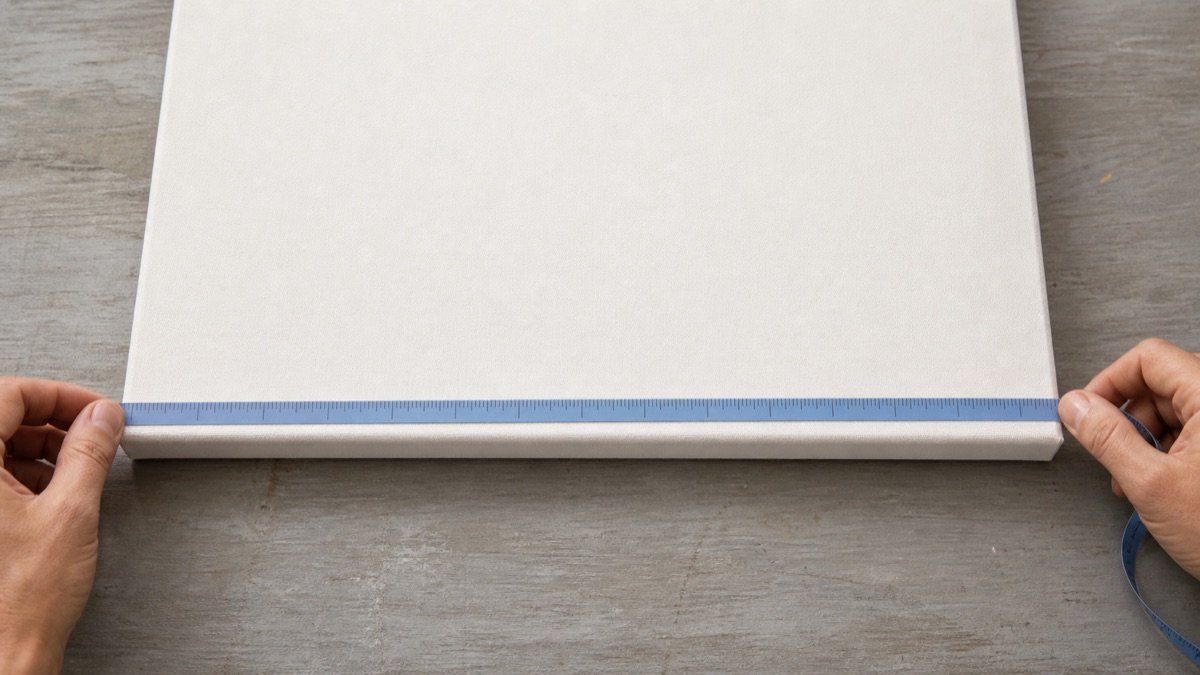
Measure a stretched canvas across the front outer edges for width and height, then measure from the front surface to the farthest back edge for depth. Record the result as width × height × depth. Keep frame dimensions separate because they describe a different outside size.
For example, a canvas may measure 16×20×1.5 inches while its finished frame measures 19×23×2 inches.
The three canvas measurements
Width
Width is the horizontal distance from the left outer edge to the right outer edge when the artwork is in its intended orientation. Hold the measuring tool straight across the front face rather than following the fabric around an edge.
Height
Height is the vertical distance from the top outer edge to the bottom outer edge. Measure the front face in the same plane as the width.
Depth
Depth is the distance from the front surface to the farthest point at the back, usually the rear edge of the stretcher bars or hardware if the hardware cannot be removed. Record removable hanging hardware separately when a framer or shipper needs the canvas itself.
Tools for measuring a canvas
- A rigid ruler or steel tape for small and medium canvases
- A long tape measure for larger work
- A carpenter’s square when you need to check whether corners are square
- A pencil or notes app to record width × height × depth immediately
- A second person for oversized work that cannot be measured safely alone
A flexible sewing tape can bend around edges and produce a longer reading. If it is the only tool available, keep it flat, straight, and lightly tensioned across the front.
How to measure a stretched canvas
- Place the canvas face up on a clean, stable surface or keep it safely upright.
- Decide which orientation is the finished top.
- Measure left outer edge to right outer edge across the front face.
- Measure top outer edge to bottom outer edge across the front face.
- Measure front to back at the deepest fixed point.
- Repeat each measurement in a second location.
- Record width × height × depth and the unit used.
Measure to at least the nearest eighth of an inch or millimeter when ordering a fitted frame. A product label such as “16×20” may be nominal; the actual stretched canvas can differ slightly.
Measure the canvas, image, and frame separately
These dimensions answer different questions:
- Canvas face: the outer width and height of the stretched support
- Painted image: the visible or painted area, which may stop before the canvas edge
- Frame outside: the total finished width, height, and depth on the wall
- Frame opening: the area through which the artwork is seen
Do not use the frame’s outside dimensions when ordering a replacement canvas. Do not use the canvas label alone when planning wall clearance. A framer may also need the canvas depth and the condition of the stretcher bars.
How to measure a framed canvas
Start by deciding what you are replacing or planning.
For wall space or shipping
Measure the finished frame from its farthest left edge to farthest right edge, then top to bottom and front to back. Include fixed protrusions that affect clearance or packing. Record removable hanging wire and hardware separately.
For replacing the artwork or inner frame
If the back is safely accessible, measure the canvas support itself rather than estimating from the visible opening. Do not remove sealed backing, fasteners, or conservation materials unless you know the object can be handled safely; ask a framer for valuable or fragile work.
For a floating frame
Measure the actual canvas face and depth. The visible gap around a floating frame is part of the frame design, not part of the canvas measurement. Give the framer exact dimensions instead of assuming the nominal size.
How to measure an unframed or rolled canvas
For an unstretched canvas:
- Lay the fabric flat without pulling it out of shape.
- Measure the painted image width and height.
- Measure the full fabric width and height separately.
- Record the unpainted margin on every side.
- Note whether the intended finished dimensions refer to the image or the stretcher.
Stretching requires additional fabric to wrap around the sides and back of the stretcher bars. The required margin depends on bar depth, fastening method, and the person doing the stretching, so confirm it before trimming the material.
Width first or height first?
Canvas listings commonly use width × height. A 24×36 canvas is 24 inches wide and 36 inches high in portrait orientation. Turn it sideways and it occupies 36 inches horizontally, but the physical support and 2:3 ratio are unchanged.
Always label the orientation or write the words “width” and “height” when communicating with a printer, framer, buyer, or shipper. This avoids relying on an assumed ordering convention.
Check the aspect ratio
Divide both dimensions by their greatest common factor to identify the exact ratio:
- 8×10 reduces to 4:5
- 12×16 reduces to 3:4
- 24×36 reduces to 2:3
- 30×40 reduces to 3:4
Two canvases with the same aspect ratio can use the same composition without cropping. If the measured support does not match the reference, use the Canvas Aspect Ratio Calculator to estimate the crop before printing or transferring the image.
Convert canvas measurements to centimeters
Multiply inches by 2.54:
- 8×10 inches = 20.32×25.4 cm
- 16×20 inches = 40.64×50.8 cm
- 18×24 inches = 45.72×60.96 cm
- 24×36 inches = 60.96×91.44 cm
- 30×40 inches = 76.2×101.6 cm
Divide centimeters by 2.54 to return to inches. Use the complete canvas sizes in centimeters chart for common formats or the Canvas Size Converter for an exact measurement.
Measuring for a wall
Use the finished frame dimensions when determining whether the piece fits a wall. Measure the usable wall after accounting for trim, switches, doors, furniture, lamps, and adjacent artwork.
For a multi-piece arrangement, add every artwork width and all planned gaps. Three 16-inch-wide canvases with two 2-inch gaps occupy 52 inches in total. The Wall Art Size Calculator can compare that total width with a measured wall or furniture piece.
Measuring for shipping
The carrier needs the packed box or crate dimensions, not only the canvas dimensions. After measuring the artwork:
- Allow space for corner protection, cushioning, and a rigid outer container.
- Measure the final package at its widest, tallest, and deepest points.
- Weigh the packed object rather than estimating from the bare canvas.
- Confirm current carrier limits and pricing before selecting packaging.
Packaging requirements vary with the artwork, value, destination, and carrier. Treat the bare canvas measurement as the starting point, not the shipping measurement.
Common canvas measurement mistakes
- Measuring the frame instead of the canvas: keep both sets of dimensions and label them.
- Following the wrapped fabric around an edge: measure straight across the front face.
- Ignoring depth: stretcher depth determines frame and packing compatibility.
- Trusting the nominal label: verify the actual support before ordering a fitted product.
- Rounding too early: preserve the measured value until the final display conversion.
- Switching width and height: state the orientation and unit explicitly.
- Measuring only once: repeat the measurement because older stretchers may not be perfectly square.
Canvas measurement questions
Do you measure canvas from the inside or outside?
Measure a stretched canvas from outside edge to outside edge across the front face. Measure the painted image or visible opening separately when that is the dimension you need.
Does canvas size include the frame?
No. A canvas size normally describes the support, while frame size can refer to either the opening or finished outside dimensions. Label each measurement to avoid ambiguity.
How do you measure canvas depth?
Measure perpendicular to the front surface from the front face to the farthest fixed rear edge. Do not wrap the tape around the side.
Should artwork dimensions be width × height?
This site consistently uses width × height. Because ordering conventions can vary, write the unit and label each dimension when sending production information.
What if opposite sides measure differently?
Record the largest outside width and height for clearance or shipping, and tell the framer that the canvas may be out of square. Do not force an old or fragile stretcher into shape without professional advice.
Once the measurements are recorded, compare nearby nominal formats in the Canvas Size Chart and keep the exact values for framing, printing, and shipping.
Related canvas and artist guides
- Canvas Sizes in CM: Standard Dimensions and Conversion Chart — Compare standard canvas sizes in centimeters and inches, from 10.2×15.2 cm to 91.4×121.9 cm, with ratios, conversion steps, and buying tips.
- Painting Sizes Chart: Standard Canvas Dimensions for Artists — Compare standard painting and canvas sizes from 4×6 to 36×48 inches, with centimeter conversions, aspect ratios, uses, framing, and choosing tips.
- Canvas Sizes in Pixels: 150, 240 and 300 PPI Chart — Find pixel dimensions for standard canvas sizes at 150, 240, and 300 PPI, plus formulas for print size, cropping, bleed, and image resolution.